YeLu NieLuGu
Demi-Gods and Semi-DevilsYeLu NieLuGu, known by the titles Prince of Chu and Lord of Southern Chancellery, is the son of YeLu ZhongYuan and the principal instigator of the rebellion against YeLu HongJi. His revolt grows out of a succession order shaped by earlier imperial choices: it challenges HongJi’s rule in the name of ZhongYuan, draws on the Southern Chancellery’s military authority, and culminates in NieLuGu’s death at Xiao Feng’s hands. Through him, the story makes inherited legitimacy and control of the army inseparable from the personal loyalties tested in the Liao crisis.
Identity and Political Position
NieLuGu is the son of YeLu ZhongYuan, the emperor’s uncle and Liao’s supreme commander, and holds the title Prince of Chu. He also governs military affairs through the Southern Chancellery, one of the two central military administrations of the Liao Empire. His father remains with YeLu HongJi on a hunting expedition, while NieLuGu stays behind in the capital; the division leaves him positioned to act from the seat of government while the emperor is away.
The offices that give NieLuGu power are part of a deliberate arrangement by HongJi. After succeeding his father, YeLu ZongZhen, HongJi elevated ZhongYuan to the status of royal emperor uncle, placing him next in the succession, and entrusted him with command of the entire army. HongJi then granted NieLuGu the title of Prince of Chu and control of the Southern Chancellery’s military affairs. The rebellion therefore comes not from an outsider seizing an institution but from a prince acting through authority and access granted by the reigning emperor.
The Succession Behind the Rebellion
The crisis reaches back to the reign of YeLu LongXu, HongJi’s grandfather. As the Holy Emperor neared death, he designated his eldest son, YeLu ZongZhen, to succeed him, although the empress favored her second son, ZhongYuan, and schemed to place him on the throne. Because the empress dowager wielded exceptional political influence in Liao, ZongZhen’s position was vulnerable. He told ZhongYuan of their mother’s plan, and the scheme was thwarted; in gratitude, ZongZhen made his brother royal emperor brother and next in the line of succession.
ZongZhen nevertheless passed the throne to his own son, HongJi, rather than to ZhongYuan. Once emperor, HongJi sought to acknowledge his uncle’s earlier sacrifice: he restored ZhongYuan’s place as next heir, appointed him supreme commander, and granted him exceptional court privileges and honors. The arrangement combined gratitude with the delegation of extraordinary power. In the narrated account, ZhongYuan had once declined the throne in favor of his brother and kept the succession intrigue quiet; HongJi therefore trusted him when he left on a hunting trip. That trust became a vulnerability when the rebellion was launched in the capital under ZhongYuan’s son.
Rebellion and Claim to the Throne
A relay of bugle calls brings news of a revolt while HongJi is away. The first report says NieLuGu has occupied the main palace and taken the empress dowager, the empress, the prince, the princess, more than a hundred officials, and their families captive. A later scout reports that NieLuGu has made his father emperor and issued a decree declaring HongJi a false ruler who had usurped the throne. The proclamation presents ZhongYuan as the legitimate sovereign and calls on the Liao army to mobilize in his support.
The claim is politically potent because it draws on the family’s recorded succession history and ZhongYuan’s recognized position as HongJi’s next heir. HongJi fears that soldiers and subjects may be persuaded by the accusation, especially because his uncle commands the main army and NieLuGu controls the Southern Chancellery. Against HongJi’s roughly one hundred thousand troops, he imagines the forces available to his uncle and cousin as overwhelming. The rebellion thus threatens more than the emperor’s person: it contests which branch of the imperial family can claim continuity and which authority the army should obey.
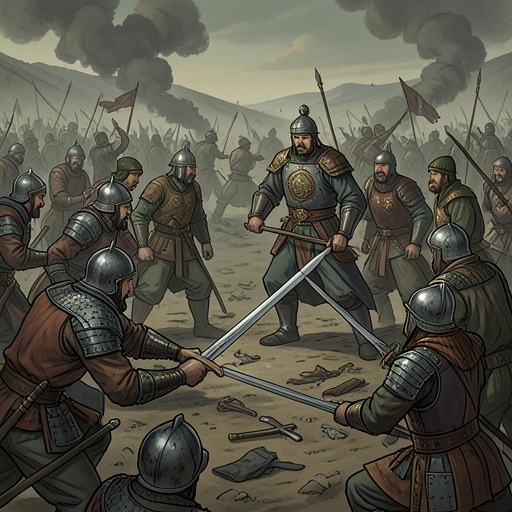
When the two forces confront one another, NieLuGu’s side sends five riders forward with a sheepskin copy of the new decree. The announcer reads that HongJi is a usurper, that the royal emperor uncle has assumed the throne, and that those who return to the capital and pledge loyalty will receive promotion. The five remain protected behind their companions’ shields as arrows are fired from HongJi’s position, then withdraw after the proclamation has been read. The episode shows the rebellion operating through both armed pressure and public claims of legitimacy: the decree is intended to unsettle allegiance before the armies decide the contest by force.
Captives and the Cost of the Campaign
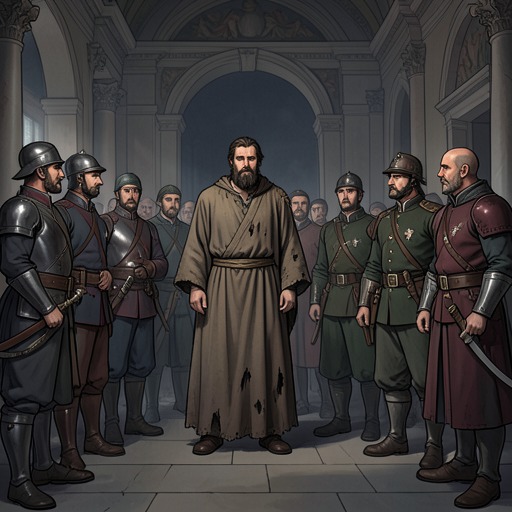
The rebellion’s use of the imperial family and civilians exposes the human stakes of the contest. When the empress dowager and empress resist being used to pressure HongJi, the Prince of Chu orders them detained and moved to the rear. He then demands the families of the opposing soldiers be brought forward. The captives include men, women, children, and elderly people; more than thirty thousand are brought before the army, although the soldiers’ families number over two hundred thousand and some of those seized have been wrongly identified.
This tactic exploits a policy HongJi had used to secure the army’s loyalty and restrain it: soldiers’ families were allowed to live in the capital. NieLuGu’s side turns that concentration into leverage against the emperor’s troops. Their cries unsettle the soldiers, whose relatives are exposed to danger, and make the rebellion’s political contest visible not only in proclamations and command structures but also in the vulnerability of people who do not control either.
Defeat and Narrative Significance
The confrontation ends with Xiao Feng’s intervention against NieLuGu. After HongJi asks Xiao Feng to kill the Prince of Chu, Xiao Feng approaches on horseback and shoots at him. A bodyguard blocks the first arrow; Xiao Feng’s next shots bring down the guard and strike NieLuGu, who is then killed by another arrow that passes through his chest. His fall is a decisive personal loss for the rebel command, though the evidence here does not describe the full military settlement that follows.
NieLuGu’s role is defined by the contradiction at the heart of the revolt: he possesses authority because HongJi’s court empowered his father and granted him command of the Southern Chancellery, yet he turns that authority against the ruler who bestowed it. The rebellion’s dynastic argument is not simply a pretext detached from history; it rests on ZhongYuan’s once-recognized place in the succession and on HongJi’s own restoration of that status. At the same time, the decree, the seizure of the capital, and the use of captives show how a claim to lawful rule is pursued through military control and coercion. NieLuGu’s death closes his part in the struggle, leaving the story’s larger question of how legitimacy, loyalty, and force intersect to be borne by the survivors.